
 0 Comments

Choosing a preschool is one of those tasks that looks rather straightforward from the outside, but can actually feel extremely daunting when the time comes around, and you’re a parent yourself. You’re not just choosing a classroom – you’re essentially picking a welcoming space where your child will feel safe, develop social skills, acquire knowledge, and become independent as a precursor to formal school.
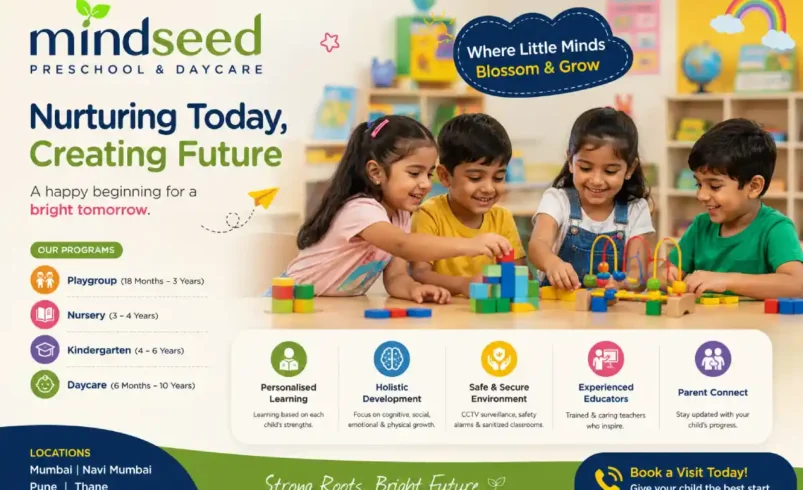
An example of one such organisation that parents might run across while wading through educational alternatives in pockets of Maharashtra is Mindseed Preschool & Daycare. The website currently shows listings of Mindseed centres in Mumbai, Navi Mumbai, Pune and Thane, and categories on offer for playschools, nurseries, kindergarten and daycare. The website lists 40+ schools, and a total of more than 25,000 children have benefited.
The feature that attracts you the most is the pedagogy of learning that Mindseed follows, which aims at equipping the individual with specific skills instead of the common learning methodology.
In this write-up, we try to delve deep into what Mindseed Preschool & Daycare stands for, what and how its pedagogy translates into learning, the age group of children it caters to, about safety procedures, and much more-including its pros, cons and aspects to weigh in while seeking admission.
What Is Mindseed Preschool & Daycare?
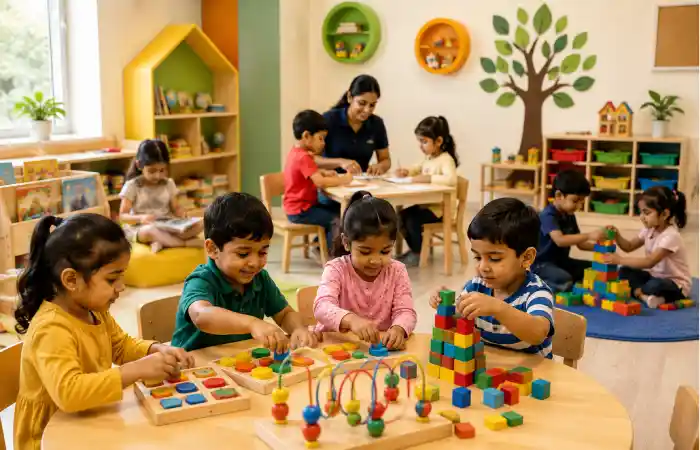
Mindseed Preschool & Daycare is a type of early learning and daycare for young children who are just about to enter or who have just begun to transition into formal schooling.
The notion of preschool is fundamentally different to the notion of formal primary schooling. Young children at this age learn by a range of means: play, talking, stories, movements, hands-on, interacting with others, and through the guidance of adults.
The method used by Mindseed is dubbed ‘personalised learning’. At its simplest, this denotes that there is no expectation that children will experience every task at the same speed.
According to Mindseed, the curriculum takes into account a child’s strengths, weaknesses and current level in an activity, and then children move onto subsequent activities once there is enough mastery for them to be able to tackle it competently.
This sort of learning can be quite beneficial for young children and during the school years when they all tend to develop at different rates. One may be very fluent and happy to talk, but hesitant to write. Another might be drawn to numbers and puzzles, but not yet keen to join in group discussions. The most effective learning environment will recognize these individual differences rather than immediately view them as difficulties.
Mindseed Preschool & Daycare Programs at a Glance
Mindseed currently lists several programs based on children’s ages. The exact availability can vary by centre, so parents should confirm the details with their local branch.
| Program | Approximate Age | Main Purpose |
| Playgroup | 18 months–3 years | Early socialisation, routines and exploration |
| Nursery | 3–4 years | Language, early literacy and developmental skills |
| Kindergarten | 4–6 years | School-readiness and broader academic foundations |
| Daycare | 6 months–10 years | Childcare alongside age-appropriate activities |
Mindseed’s official program information lists playgroup, nursery, kindergarten and daycare within its current offering.
What Does Personalised Learning Mean at Mindseed?
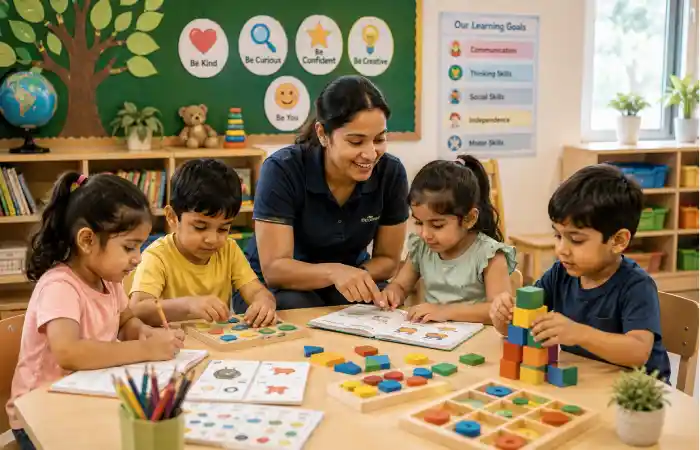
Personalized Learning – Sounds like some confusing, or, should I say ‘what IS learning actually’ thing doesn’t it? Well, let me tell you… Just picture five kids in a group during some learning activity.
You will see one understand the concept straightaway, another will be able to learn it from someone showing them, then one kid who really only learns when interacting with concrete objects.
And another kid who finally gets a concept only after hearing a story that helps them. Personalized teaching tries to create space for this difference. According to Mindseed, kids progress in activities according to their abilities, skills, and interests. The purpose is to keep them engaged rather than pressuring them to keep up with other kids. This may be one of the key lessons every parent needs to take from Preschool.
Preschool is not a training program to dump more and more Information for kids.
It’s more about how you help them get comfortable with the very process of learning, and I think this can make all the difference – Because every child who is good at talking, asking, experimenting, and trying again would continue to have positive learning experiences that follow beyond the scope of PreSchool.
What Do Children Learn at Mindseed?
Mindseed says its preschool curriculum focuses on several areas of development rather than academics alone.
These include:
- Language and communication
- Social and emotional development
- Physical development
- Cognitive development
- Fine and gross motor skills
- Early reading and writing
- Problem-solving
- Independence
- Sharing and social interaction
The organization describes language development through activities involving listening, speaking, reading and writing. Cognitive development can include activities such as sorting, pattern recognition and problem-solving. Physical development involves both fine and gross motor activities.
Language Development
Mindseed informs that the instruction language at its centres is predominantly English, but its teachers have adopted a simple linguistic approach which the youngsters could comprehend readily. Tasks like story writing, phonics, and speaking would help children to overcome their uneasiness when it involves language usage.
Social Development
A preschool classroom can also be seen as a mini social environment.
Children learn to wait their turn, to share materials, to listen to other children and to use their words if something is wrong.
While those abilities appear elementary to an adult, these can be significant developmental leaps for a young child.
Physical Development
Preschool should not mean sitting at a desk for several hours.
Children need movement.
Activities involving running, climbing, manipulating objects, drawing, coloring and building can support gross and fine motor development.
Mindseed says its centres incorporate gross and fine motor activities as part of its broader developmental approach.
A Typical Day at Mindseed Preschool
One interesting aspect of Mindseed’s program is the structure of a typical day.
The official preschool program describes a routine involving:
- Attendance
- Circle time
- Skill Station 1
- Break
- Skill Station 2
- Skill Station 3
- Goodbye
The purpose of having a routine is not simply to keep children organised.
Young children generally benefit from knowing what comes next.
A predictable sequence can make the environment feel easier to understand. Over time, children can begin recognizing transitions themselves: arrival means settling in, circle time means group interaction, skill stations mean focused activities, and the end of the day means preparing to go home.
That small sense of predictability can make a big difference to a child’s confidence.
Mindseed Playgroup: The First Step Into Preschool
Mindseed lists its playgroup program for children approximately 18 months to 3 years old.
At this stage, formal academic expectations should generally be secondary to basic developmental experiences.
Children are learning how to:
- Be away from parents for a period of time
- Follow simple routines
- Communicate with adults
- Interact with other children
- Explore their surroundings
- Improve coordination
- Become more independent
The transition into preschool can be emotional for both children and parents.
Some children walk into the classroom without looking back. Others need several days—or weeks—to become comfortable.
There is no single “correct” reaction.
A good preschool should allow children time to adjust while maintaining a consistent routine.
Mindseed Nursery: Building Early Learning Skills
Mindseed’s nursery program is aimed at children around 3 to 4 years old. Its nursery information highlights early reading development, stories and independent exploration.
At this age, children are becoming increasingly curious about letters, words, sounds and numbers.
But learning should still feel playful.
For example, learning letter sounds can happen through songs and stories. Counting can happen while sorting objects. Vocabulary can grow through conversation about pictures and everyday activities.
The goal is to create connections.
When children understand that letters represent sounds, numbers represent quantities, and stories communicate ideas, formal education becomes less unfamiliar later.
Mindseed Kindergarten and School Readiness
Mindseed lists kindergarten for approximately 4 to 6 years.
Kindergarten is an important bridge between preschool and primary school.
Children at this stage are gradually expected to become more comfortable with:
- Reading and writing
- Basic mathematical concepts
- Following instructions
- Speaking in front of others
- Completing activities
- Working independently
- Participating in group activities
Mindseed’s stated learning outcomes include areas such as story creation, communication and confidence.
The important point is that school readiness is broader than knowing the alphabet or counting to a particular number.
A child who can listen carefully, ask for help, sit through an activity, communicate with classmates and manage simple personal tasks may be much better prepared for school than a child who has simply memorized worksheets.
Mindseed Daycare: More Than Just Childcare
For working parents, preschool and daycare often need to work together.
Mindseed lists daycare for children from approximately 6 months to 10 years, although parents should confirm age eligibility and services with the specific centre.
Daycare serves a different purpose from preschool.
Preschool is primarily an early-learning environment, while daycare provides extended care and supervision around a child’s daily routine.
Mindseed’s admission information says its daycare includes attention to nutrition, with meals planned with the involvement of a nutritionist, while preschool meals may involve an additional charge.
For parents considering daycare, however, food is only one consideration.
You should also ask about:
- Nap arrangements
- Feeding schedules
- Pick-up procedures
- Staff-to-child ratios
- Outdoor play
- Screen use
- Hygiene routines
- Emergency procedures
- Communication with parents
These practical details can matter just as much as the curriculum.
Safety and Security at Mindseed
Parents naturally would like to be reassured about what is happening behind closed doors.
According to Mindseed’s admission details, its centres are equipped with the provision of emergency exits, emergency alarm systems and security systems such as CCTV surveillance, while the preschool programs webpage further states :
We practice strict safety precautions. We also feature sanitised classrooms that offer the latest CCTV coverage.
Still, online information should never replace an in-person visit.
When visiting a centre, look beyond the brochure.
Check whether:
- Doors and gates are properly controlled.
- Electrical points are protected.
- Toys appear clean and well maintained.
- Floors and play areas are safe.
- Children are supervised during outdoor activities.
- Emergency exits are clearly accessible.
- Staff members interact patiently with children.
- The center has a clear authorized pick-up process.
Sometimes the smallest details tell you the most about a preschool.
Comparison: Mindseed vs a Traditional Preschool
Rather than saying one model is universally better, it is more useful to compare the general approaches.
| Factor | Mindseed Approach | Traditional Preschool Approach |
| Learning pace | Personalised | Often more uniform |
| Curriculum | Skill-based and personalised | Often age/grade-based |
| Learning style | Activities and skill stations | May rely more on worksheets |
| Development | Holistic | Can vary by school |
| Routine | Structured daily sequence | Usually structured |
| Parent decision | Centre visit remains important | Centre visit remains important |
This table should not be interpreted as saying that every traditional preschool works the same way. Preschool quality depends heavily on the individual centre, teachers, leadership and classroom environment.
What Makes Mindseed Different?
The biggest point of difference is its focus on individual learning journeys.
Many parents are familiar with the traditional idea that an entire class should learn the same lesson at the same time.
Mindseed’s stated philosophy takes a different route.
The organisation says children can move to new levels after mastering activities, with learning adjusted according to individual strengths and needs.
That can be appealing to parents who do not want preschool to become a race.
There is also an emphasis on skills beyond textbook knowledge.
Communication, confidence, independence, social interaction and problem-solving are difficult to measure on a simple report card, but they are valuable parts of childhood development.
Advantages of Mindseed Preschool & Daycare
Based on its published program information, several features may appeal to parents.
1. Personalized Learning
Children are treated as individuals rather than identical learners.
2. Multiple Age-Based Programs
Parents can explore playgroup, nursery, kindergarten and daycare options within the same organisation.
3. Skill-Based Activities
The curriculum focuses on skills such as language, cognitive development, social development and motor development.
4. Structured Daily Routine
A predictable routine can help young children understand their day.
5. Safety Focus
Mindseed highlights CCTV surveillance, emergency exits and safety measures at its centres.
6. Parent-Focused Progress Tracking
Mindseed says parents can use its app to track milestones.
Things Parents Should Check Before Admission
Even when a preschool looks excellent online, the final decision should be based on the actual branch your child will attend.
This is particularly important because facilities, staff and classroom environments can differ from one centre to another.
Before paying an admission fee, ask:
What is included in the fee?
Find out whether registration, tuition, meals, activities, uniforms, transport and daycare are separately charged.
How many children are there in one classroom?
A smaller class may allow teachers to give more individual attention, although staff quality is equally important.
What happens if my child cries?
The answer can tell you a lot about how the centre handles emotional transitions.
How are parents informed about progress?
Ask whether updates are provided through an app, meetings, written reports or conversations with teachers.
What happens during an emergency?
Do not hesitate to ask for details about evacuation, medical support and authorized pick-up procedures.
Is Mindseed Preschool & Daycare Right for Your Child?
There is no single preschool that is perfect for every family.
Mindseed may be worth considering if you prefer an environment that emphasises:
- Personalised learning
- Skill development
- Play and activity-based learning
- Communication
- Independence
- Social development
- Structured routines
- Preschool and daycare in one setting
On the other hand, parents who prefer a highly traditional academic environment may want to compare Mindseed with other schools before deciding.
The best choice depends on your child’s personality, your working schedule, location, budget, preferred teaching style and the quality of the specific centre.
How to Choose the Right Mindseed Centre
Don’t pick a location just by distance. Visit your centre. Spend some time there simply watching.
The way the teachers treat the children – do kids look relaxed and unhurried? Is the room and the school clean, well-lit and orderly?
But most of all – look to your child! How to tell if a child is enjoying their first visit to their care centre without them saying much. Let the child do some exploring in the class – to touch the toys, look around, and interact. An obviously unhappy child in that room could simply need a bit more time — or not the right room for him/her.
Final Thoughts on Mindseed Preschool & Daycare
At Mindseed Preschool & Daycare, the education pedagogy is rooted in personalization, skills, and the premise that all children don’t learn the same way. The current programs include playgroup, nursery, kindergarten, and daycare with centers identified in Mumbai, Navi Mumbai, Pune, and Thane. The one simple takeaway for parents: preschool isn’t just training for the next grade; it’s training for learning.
Also Read: https://www.thebusinesscart.com