
 0 Comments

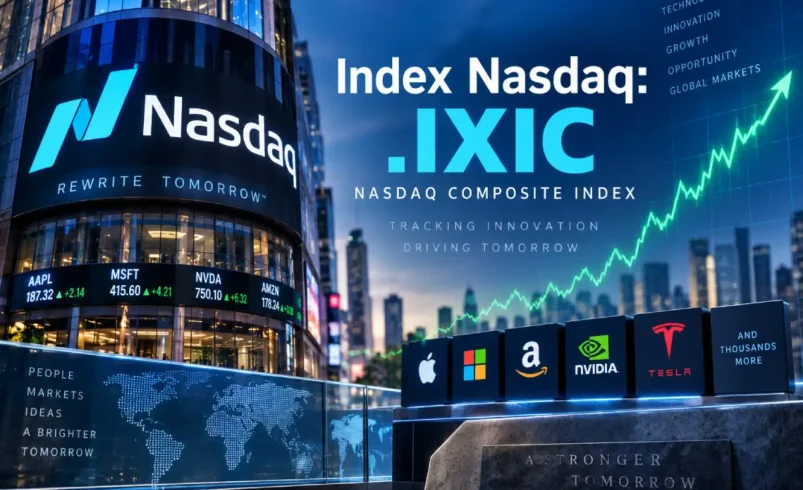
indexnasdaq: .ixic: When you see Index Nasdaq:IXIC on a financial website, odds are good you’re looking at the Nasdaq Composite Index. This is a stock market index followed by many financial websites that uses the symbol (.IXIC). The index is well-known for its tech-heavy, growth-oriented index and is often referenced as the index with the most exposure to technology stocks.
The index is not a single company but rather a collection of companies that trade on the Nasdaq Stock Market. It’s similar to the Dow Jones Industrial average, in that the index itself is not a single investment, but rather a measurement of other stocks’ performance.
What Is Index Nasdaq:IXIC?

Index Nasdaq:. IXIC is the most commonly used ticker symbol for the Nasdaq Composite Index. Who We Cover The Nasdaq Composite was founded in 1971 with the goal of tracking stocks of companies listed on the Nasdaq Stock Market.
Today, Nasdaq covers domestic and international common-type securities listed only on Nasdaq per its index eligibility criteria.
One caveat, though, is that the Nasdaq Composite is much broader than the narrow index known as the Nasdaq-100: The broad Composite encompasses thousands of stocks, and the narrower Nasdaq-100, just 100 of the largest nonfinancial stocks listed on Nasdaq. As of 26 September, the Nasdaq’s index page held 3,392 components.
Definition of the Nasdaq Composite Index
Definition: The Nasdaq Composite Index is a stock market index of the common stocks and similar securities listed on the Nasdaq stock market. In the context of stocks and investing, picture thousands of companies on Nasdaq as one giant basket containing their collective market value. If the overall market is going up, this index does too.
The index is particularly associated with technology because many influential technology companies are listed on Nasdaq. However, calling it simply a “technology index” would be inaccurate. The Composite also includes companies from healthcare, financials, consumer sectors, industrials, real estate, and other areas. Nasdaq states that the index covers all 11 ICB industry groups.
How Does .IXIC Work?
The Nasdaq Composite uses market capitalization weighting.
What does market capitalization mean?
The total value of a company’s shares on the open market. For example, if a company has a billion shares of stock outstanding and its shares are worth $ 100 each, then its market cap is roughly $ 100 billion. Some indexes are weighted in proportion to market cap; that is, larger companies have a greater impact than smaller companies. A large movement in a very large company listed on the Nasdaq, for example, can have an impact on the aggregate value of the Nasdaq Composite.
Why Is the Nasdaq Composite Important?
The Nasdaq Composite gets a lot of attention from investors, strategists, traders, and financial journalists because it’s an indicator of the entire Nasdaq-listed market.
It’s especially useful when tech, AI, semiconductors, cloud computing, software or other growth sectors are showing robust results.
However, the Composite is also made up of many smaller names that don’t always garner the same attention as the bigger technology companies, which helps make it wider than many people believe.
What indexes does Nasdaq offer? The Nasdaq says it has more than 3,000 companies and provides exposure across sectors, sizes, and geography.
Nasdaq Composite vs. Nasdaq-100
One of the most common sources of confusion is the difference between the Nasdaq Composite and Nasdaq-100.
| Feature | Nasdaq Composite (.IXIC / COMP) | Nasdaq-100 (NDX) |
| Main purpose | Broad Nasdaq-listed market benchmark | Large-cap Nasdaq benchmark |
| Number of companies | More than 3,000 | 100 |
| Financial companies | Included | Generally excluded |
| Weighting | Market-cap weighted | Modified weighting methodology |
| Company sizes | Large, medium and smaller companies | Primarily large companies |
| Technology exposure | High, but diversified | Very high |
The distinction matters because the two indexes can move differently. The technology index is a bit broader, however, while the Nasdaq-100 focuses on a collection of large non-financial Nasdaq-listed companies. Together with 2500 stocks in the total index, as much as 104 shares are included in the Nasdaq-100; it additionally considers a lot more small properties than the index.
What Companies Are Found in IXIC?
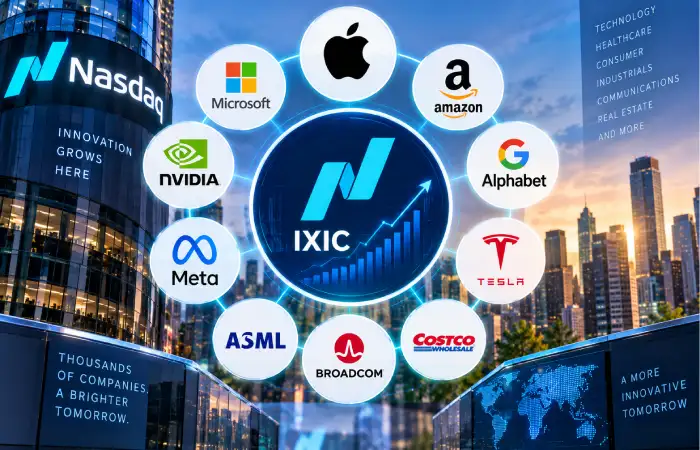
The Composite can include some of the most recognizable companies in the world alongside smaller and emerging businesses.
Large Nasdaq-listed names have historically included companies such as Apple, Microsoft, Amazon, NVIDIA, Alphabet, Meta and Tesla. Nasdaq has also highlighted the index’s exposure to thousands of smaller companies and businesses outside the technology sector.
This mixture is one of the index’s biggest strengths. An investor looking at .IXIC is not seeing the performance of only a handful of famous technology stocks.
Instead, the number represents the combined performance of a much wider Nasdaq-listed universe.
Why Does .IXIC Move So Much?
Several factors can influence the Nasdaq Composite.
Interest rates are particularly important. Growth stocks are typically priced in part on forward earnings. As rates rise, those future earnings may appear less attractive in valuation models, and the stocks may come under pressure. Earnings are also a factor; earnings reports can lift a company higher or send it tumbling.
Technology trends can have an outsized influence because technology companies represent a substantial portion of the index’s weight. Nasdaq currently reports that technology accounts for more than half of the Composite’s weight.
Other influences include inflation, economic growth, currency movements, government policy, geopolitical developments and investor sentiment.
Is the Nasdaq Composite the Same as “Nasdaq”?
Not exactly.
In everyday financial conversations, people sometimes say “the Nasdaq” when they mean the Nasdaq Composite. Financial websites may display IXIC, IXIC, COMP, or another platform-specific identifier.
However, Nasdaq can also refer to the stock exchange itself or to other Nasdaq indexes.
That distinction is worth remembering. The Nasdaq Stock Market is an exchange where securities are traded, while the Nasdaq Composite is an index that measures a broad group of eligible securities listed on the exchange.
Can You Invest Directly in .IXIC?
An index itself is generally a measurement rather than a traditional security that you purchase directly.
However, investment products can be designed to track an index. Nasdaq lists products connected with the Nasdaq Composite, including the Fidelity Nasdaq Composite Index Tracking ETF (ONEQ).
Before investing in any index-tracking product, investors should examine its expense ratio, tracking approach, liquidity, tax considerations and overall suitability.
Final Thoughts
IndexNasdaq: .IXIC is essentially a window into the broad Nasdaq-listed stock market. Its reputation for technology exposure is deserved, but the index is considerably more diverse than the phrase “technology index” suggests.
Its thousands of components, market-capitalization weighting, and inclusion of companies across different industries make it useful as a broad market benchmark. At the same time, its significant technology exposure means that developments in innovation, interest rates, corporate earnings and growth-stock valuations can strongly influence its direction.