
 0 Comments

It has been noted that Psalm 19:1-4 is one of the loveliest passages in Scripture detailing how creation points to the glory of God. In just a short number of verses, the psalmist details heaven and the sky, day and night, and the general testimony that comes forth from all of creation. The idea that creation shows off God without uttering a single human sentence, although powerful, is still somehow clear.
As readers read these verses, it can be a good occasion to stop and look at the created order of things. A sunrise, an empty sky filled with stars, seasons, and nature’s silent majesty can all be reminders of more than words can say.
What Is Psalm 19:1–4?

Psalm 19:1-4 is the opening of Psalm 19, which is commonly attributed to David. This psalm speaks of General Revelation, which is revelation through creation. This psalm opens by saying that the heavens declare the glory of God and the firmament displays the work of His hand in verse 1.
This goes further by, in the following verses, showing how creation perpetually declares its praise to the Lord.
The thing that is essential to recall here is that creation is not just visually pleasing to look at. The psalmist makes the claim that creation testifies of its Creator.
Definition: General Revelation
General revelation is man’s ability to understand who God is by looking at the creation, the natural world, human consciousness, and the sense of order in the universe. It is called “general” because anyone at any time is exposed to it; it’s not specific to certain individuals. One of the most famous passages about this topic in scripture is Psalm 19:1-4.
Psalm 19:1–4 Meaning
The first four verses can be understood as a poetic description of the universe as a testimony to God’s glory.
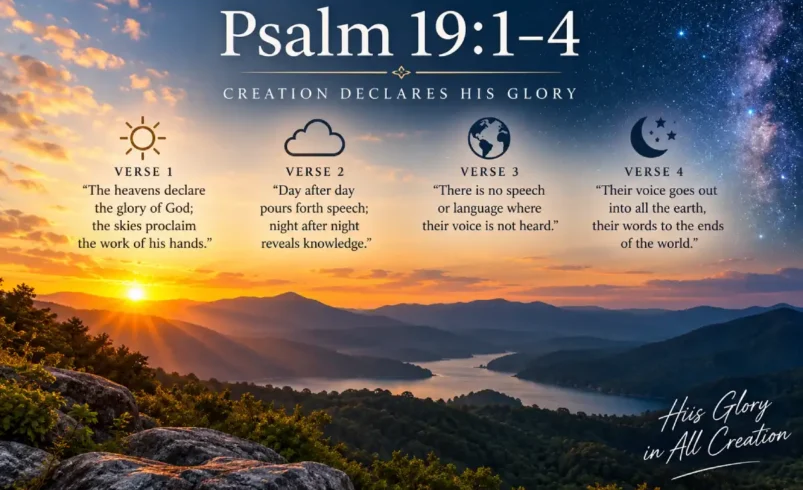
“The heavens declare the glory of God”
Declare is also a central word because it helps build up this central image that’s being conveyed. The heavens are almost presented as if someone is announcing or proclaiming something. The stars, planets, clouds, and vast heavens, for the psalmist, point to the awesomeness of God and His artistry.
The psalmist is NOT claiming that heaven is speaking in human language! Creation is still speaking; but not through speech as ordinary people do. One can look up at the stars and feel little, astonished, and in awe, and for the psalmist, that awe speaks of God’s glory.
“The skies proclaim the work of His hands”
This second part expresses the role of God as creator.
Instead of saying that the world has no meaning, he says that it is God’s ‘work’ which he made with his own hands. This implies an ‘artist’s’ approach-that something wonderful has been carefully constructed.
It also alters ordinary believers’ perception of everyday things. Nature is not just decoration; it can be an invitation to find God’s work.
Day and Night as Continuous Witnesses

The second verse of Psalm 19 states that day after day pours out speech and night after night declares knowledge.
There is one part of the verse that really stands out, in that it has a constant feeling. The witnessing that creation does cannot be limited to specific events or moments; rather, it happens continuously every day. Both the dawn and the midday sun and the day’s sunset and the night itself all partake in the process. The Psalmist appears to see in the nature around him a process and cadence which constantly points to God.
Definition: Spiritual Reflection
Spiritual reflection is the process of reflecting on one’s religion, experiences, situation, and relationship with God. Psalm 19:1-4 naturally prompts spiritual reflection, as it asks its reader to look beyond their physical surroundings and ponder how the created world might bear witness to its Creator.
A Comparison of the Main Images in Psalm 19:1–4
| Image | What It Represents | Main Spiritual Idea |
| Heavens | The vastness of creation | God’s greatness |
| Skies | God’s creative work | God’s craftsmanship |
| Day | Ongoing revelation | God’s message continues |
| Night | Quiet testimony | Knowledge can be discovered through reflection |
| The whole world | Universal witness | Creation points beyond itself |
The passage becomes especially powerful when these images are considered together. The heavens show God’s greatness, while day and night emphasize that this testimony is continuous.
Creation Communicates Without Words
One very interesting point in Psalm 19:1-4is the paradox of speech versus silence. In verse 3 we are told, There is no speech or language, nor is it heard. Creation “speaks” apart from any vocal language.
And that has very significant universal implications.
There are thousands of human languages, but the beauty of a sunrise and the majesty of mountains are experiences that belong to everyone on Earth. Psalm 19 uses a similar universal form of revelation. There isn’t a certain amount of vocabulary one needs to grasp this concept. No one needs to know Hebrew, Greek, Latin, or even one of many contemporary languages; we all can see the stars.
What Does Psalm 19:1–4 Teach Christians?
For the Christian, the text holds several implications. First, it encourages worship. Our culture is often fast-moving and cacophonous, and the created world seems to pass us by with all too little notice.
The lesson of Ps 19 is to slow down and appreciate the glory all around us.
Third, the enormous vastness of the cosmos prompts us towards humility. We are, it implies, much smaller than we think and a part of an enormous, awe-inspiring creation. Third, this helps create a sense of gratitude. If creation is attributed to God, even the mundane becomes an act of glory.
Lastly, Ps 19:1–4 shows that faith does not reside only within the walls of a church but exists everywhere we go.
Psalm 19:1–4 and Modern Life
The principle taught in this passage is still true, even in the twenty-first century. People spend hours staring at their screens, getting phone notifications, working, studying, and jumping from one task to the next. Psalm 19 provides an alternative cadence: looking up, noticing, reflecting.
Just a few minutes outside quieted your heart and mind and prompted some reflection.
Observing the clouds sailing across the sky, or watching the first few stars come out, may seem trivial to the lost. However, these observations can speak to the soul of the believer. However, no long, involved spiritual program is suggested. All the command calls for is the simple act of noticing creation and letting it move you.
Why Psalm 19:1–4 Is So Powerful
Psalm 19:1–4 combines theology with poetry in a way that makes its message memorable. Rather than presenting a dry argument about God’s existence, David uses images that people can experience.
The heavens become a declaration.
The skies become a display of craftsmanship.
Day and night become continual witnesses.
Creation itself becomes a silent testimony.
That is why these verses have remained meaningful to generations of readers. They transform something familiar—the world around us—into a reminder of something eternal.
Final Thoughts
The creation story can direct the heart of humanity back to the glory of God according to Psalm 19:1-4. The heavens show the glory of God; the skies make the worship of Him known, and the day-upon-day rotation in both darkness and light causes mankind to stand in awe of His Creator on an ongoing basis.
It seems most poignant in the lesson that the testimony in this passage is given without words. We are called to wonder at creation: The world itself is its testimony.
There is a lesson for all of us, especially on those hurried days, to lift our heads from whatever we are focused on and gaze at the heavens; the poem sees it as having an ability that goes far beyond being a backdrop for whatever it is that we are engaged in as we move through life.
Also Read: https://www.thebusinesscart.com