
 0 Comments

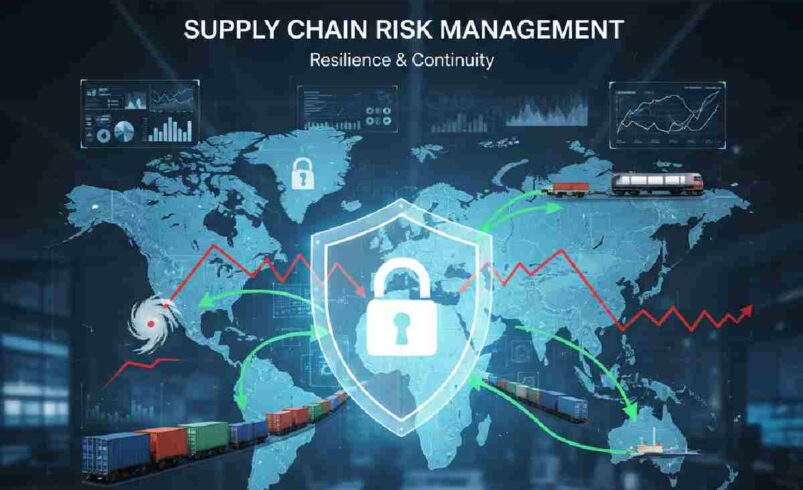
In 2026, supply chain risk management has moved from a back-office concern to a boardroom priority. Global disruptions—from geopolitical tensions and climate shocks to cyberattacks and supplier insolvencies—have made it clear that traditional, linear supply chains are fragile.
Organizations that fail to invest in proactive supply chain risk management face higher operational costs, revenue loss, regulatory penalties, and reputational damage. On the other hand, companies that treat risk as a strategic discipline are gaining a competitive edge through resilience, visibility, and agility.
This article explores it in depth—its types, costs, tools, country-wise adoption, and future trends—supported by research tables, pricing data, and actionable insights.
What Is Supply Chain Risk Management?
It is the systematic process of identifying, assessing, mitigating, and monitoring risks across the entire supply chain—from raw material sourcing to last-mile delivery.
Core Objectives of Supply Chain Risk Management
- Reduce operational disruptions
- Protect revenue and customer trust
- Ensure regulatory and ESG compliance
- Improve supplier reliability
- Enhance long-term resilience
Unlike reactive crisis handling, modern supply chain risk management emphasizes predictive intelligence and real-time response.
Key Types of Supply Chain Risks in 2026
- Operational Risks
- Supplier failure or bankruptcy
- Manufacturing downtime
- Labor shortages
- Geopolitical Risks
- Trade sanctions
- Tariff volatility
- Border closures
- Cyber and Technology Risks
- Ransomware attacks on logistics systems
- ERP and IoT vulnerabilities
- Data breaches
- Environmental and Climate Risks
- Extreme weather events
- Resource scarcity
- Carbon regulation compliance
- Financial Risks
- Currency fluctuations
- Inflation-driven cost spikes
- Credit risk of suppliers
Supply Chain Risk Categories and Impact
| Risk Category | Example | Business Impact | Risk Severity (2026) |
| Operational | Supplier shutdown | Production halt | High |
| Geopolitical | Trade sanctions | Delayed shipments | High |
| Cyber | Logistics ransomware | Data & revenue loss | Critical |
| Climate | Flooded ports | Inventory shortage | High |
| Financial | Currency volatility | Margin erosion | Medium |
The True Cost of Poor Supply Chain Risk Management
Failing to implement effective supply chain risk management can be extremely expensive.
Hidden and Direct Costs
- Revenue loss from stockouts
- Emergency sourcing premiums
- Contract penalties
- Brand trust erosion
- Regulatory fines
Estimated Annual Losses by Company Size
| Company Size | Avg. Annual Loss Without Risk Mgmt |
| Small Business | $250,000 – $500,000 |
| Mid-Market | $1M – $5M |
| Enterprise | $20M+ |
Supply Chain Risk Management Strategies That Work
- Supplier Diversification
Avoid single-source dependencies by onboarding regional and secondary suppliers.
- Digital Supply Chain Visibility
Use AI-powered dashboards to monitor inventory, logistics, and supplier performance in real time.
- Predictive Risk Analytics
Machine learning models detect early risk signals—financial stress, shipment delays, or geopolitical threats.
- Inventory Buffer Optimization
Balance just-in-time efficiency with strategic safety stock.
- Scenario Planning and Stress Testing
Simulate disruptions to validate response strategies before crises occur.
Tools and Software
| Tool Name | Key Features | Pricing (Annual) | Best For |
| SAP Ariba | Supplier risk scoring, compliance | $15,000–$50,000 | Enterprise |
| Oracle SCM Cloud | Predictive risk analytics | $12,000+ | Large orgs |
| Resilinc | Event monitoring, risk alerts | $10,000–$40,000 | Global supply chains |
| Llamasoft (Coupa) | Scenario modeling | $8,000–$30,000 | Strategy teams |
| Riskmethods | Real-time risk mapping | $6,000–$25,000 | Mid-market |
Country-Wise Adoption of Supply Chain Risk Management
Global Leaders in 2026
| Country | Adoption Level | Key Drivers | Common Industries |
| USA | Very High | Cyber risk, ESG | Tech, Retail |
| Germany | High | Compliance, automation | Manufacturing |
| China | High | Export resilience | Electronics |
| India | Medium–High | Cost volatility | Pharma, FMCG |
| Japan | High | Disaster preparedness | Automotive |
India’s Perspective
India’s supply chain risk team adoption is accelerating due to:
- Export growth
- Regulatory digitization
- Climate-related disruptions
Indian firms increasingly invest in AI-based risk platforms priced between $3,000–$15,000 annually.
Supply Chain Risk Management and ESG Compliance
Environmental, Social, and Governance (ESG) mandates now intersect directly with supply chain risk team.
ESG-Related Risks
- Child labor violations
- Carbon emission non-compliance
- Unsafe supplier working conditions
Benefits of ESG-Integrated Risk Management
- Easier regulatory audits
- Improved investor confidence
- Stronger brand reputation
Role of AI and Automation
By 2026, AI is no longer experimental—it is foundational.
AI Capabilities
- Predict supplier failures months in advance
- Monitor news, weather, and financial data
- Automate supplier risk scoring
Impact Metrics
- 30–45% faster disruption response
- 20% lower logistics costs
- 35% improvement in forecast accuracy
Best Practices Checklist
- Conduct supplier risk audits quarterly
- Use multi-tier supplier visibility
- Align risk KPIs with business goals
- Train teams on crisis response
- Review geopolitical exposure annually
The Future of Supply Chain Risk Management
Looking ahead, it will evolve in three major ways:
- Hyper-automation using AI agents
- Regionalized supply networks
- Real-time compliance monitoring
Organizations that invest early will turn resilience into a strategic advantage—not just a defensive shield.
Conclusion:
In an unpredictable global economy, it is no longer about avoiding disruption—it’s about thriving despite it. Companies that combine technology, strategy, and global awareness will outperform competitors on cost, reliability, and trust.
As 2026 unfolds, the question is no longer whether to invest in supply chain management—but how fast you can implement it.